When should you collaborate…?
I’ve seen too many leadership teams become paralysed — stuck in discussion, unable to move to a clear, coordinated decision. And too many leaders unsure of what their role is in those moments.
So I thought I’d write a little about collaboration.
When should you collaborate… and when should you be directive?
I see a lot of leaders get caught on this question.
As if it’s a choice to be made cleanly:
Do I involve people… or do I decide?
But in practice, it rarely shows up like that.
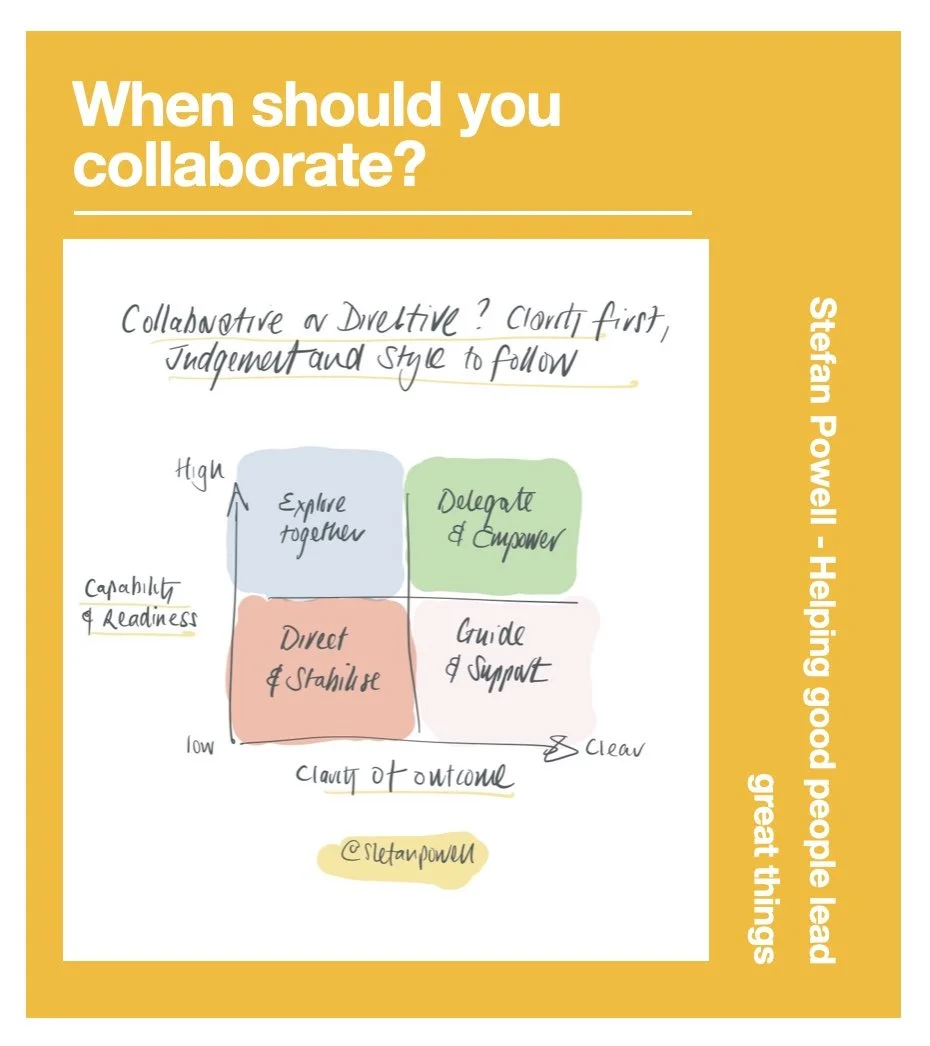
Most of the time, you’re somewhere in between - feeling your way through a moment that isn’t quite defined yet, working out what’s needed, and what part you need to play in it.
There’s a body of thinking behind this.
Frameworks like Situational Leadership have been around for years, suggesting that different situations call for different approaches - directing, coaching, supporting, delegating.
And that’s helpful… to a point.
But reality tends to move faster than frameworks.
Situations shift.
People shift.
Pressure shifts.
You don’t get to pause, diagnose, and then neatly select a style.
You’re already in the room.
What I see, over time, is that leaders develop something more fluid.
They start reading what’s in front of them.
A kind of quiet assessment begins to happen:
Do they really understand what’s being asked?
Do they have the capability to take this on?
Do they actually want to?
And alongside that:
How clear is the outcome?
How much time do we really have?
From there, something in you starts to lean one way or another.
Not as a fixed identity - but as a response to the moment.
Where it can become unhelpful is when we turn it into a moral judgement.
Collaboration is seen as the “good” way to lead.
Direction as something to be avoided.
Or, in some environments, the opposite is true.
But the reality is more nuanced than that.
You can be very clear on the outcome, the boundaries, the pace - and still invite people into the thinking.
And you can open something up for collaboration, but hold it well enough that it doesn’t lose shape or direction.
So the question shifts.
Not “am I being collaborative enough?”
But:
Where does the thinking need to sit, right now? And how and who do i need to be right now?
There’s also a layer to this that’s harder to describe, but just as important.
Over time, you start to feel your way through these moments.
You walk into a conversation and something in you notices:
They don’t quite see it yet.
They might be able to do it, but they’re unsure.
They’re not fully engaged.
Or sometimes the opposite:
They’ve got this.
They just need space.
Or occasionally:
This needs holding, for now.
We tend to call that instinct.
But it isn’t random.
It’s pattern recognition - built over years of experience, seeing how similar situations unfold.
And still, instinct on its own isn’t enough.
Because it can lead you to step in too quickly, or hold back when something actually needs your voice.
So there’s a second step.
A small one, but an important one.
You test it.
One of the simplest ways to do that is to ask:
How could I be most helpful right now?
And then genuinely listen to what comes back.
Because when someone says, “tell us what you think”, it’s easy to assume they’re stepping away from responsibility.
Sometimes they are.
But often, they’re telling you something else.
That they’re stuck.
That they need a steer.
That they trust your judgement.
And even then, you don’t have to take everything on.
You can stay with them in the work.
You can ask:
What do you see as the pros and cons here?
What feels unclear?
What would make this stronger?
In doing that, you’re still leading.
But you’re not removing ownership.
Too much openness, and things begin to drift.
Too much direction, and people comply, but don’t fully engage.
Somewhere in between is where most of the work sits.
Clear intent.
Clear edges.
And enough space for people to think and contribute.
So when should you collaborate, and when should you be directive?
You start with clarity. Most people don’t have clarity to work torwards; this is key.
You use your judgement. Your instincts are based upon experience - trust them more.
And then you choose how to show up. You have more flexibility and licence than you think.
Sometimes that means setting direction.
Sometimes it means sharing the thinking.
Often, it’s a blend of both.
Clarity first. Judgement second. Style follows.
Or, put another way:
Set the direction where it’s needed.
And share the thinking wherever you can.
And then ensure you ask for ‘theirs’.

Executive Coach and writer on leadership, stewardship and the responsibilities that come with influence.
Enjoyed reading this? Consider doing one of these:
Get in touch - If any of this topic resonated with you and you have something you’d like to share with me or if you’d like to discuss working with me on this topic - stefan@stefanpowell.co.uk works really well for me.
Read more about how I help individuals, teams and organisations here
Book an inquisitive session with me to find out more about what I do and how I do it or run a challenge or thought you have passed me.
Connect with me on linked in and read my long form posts on the rotating topics of Work, Rest. Play, Sustenance and Love every Thursday
Sign up to my newsletter ‘Be The Waves” here - which collates each weeks long form post on a monthly basis and you’ll get to read it later in the month
Follow me on strava.