This blog reflects on how the causes worth carrying are often born from the experiences that have shaped us, the frustrations we’ve faced, and the futures we want to create for others. It explores the shift from achievement to stewardship, asking not just what we can accomplish, but what is worthy of our time, energy, courage, and contribution.
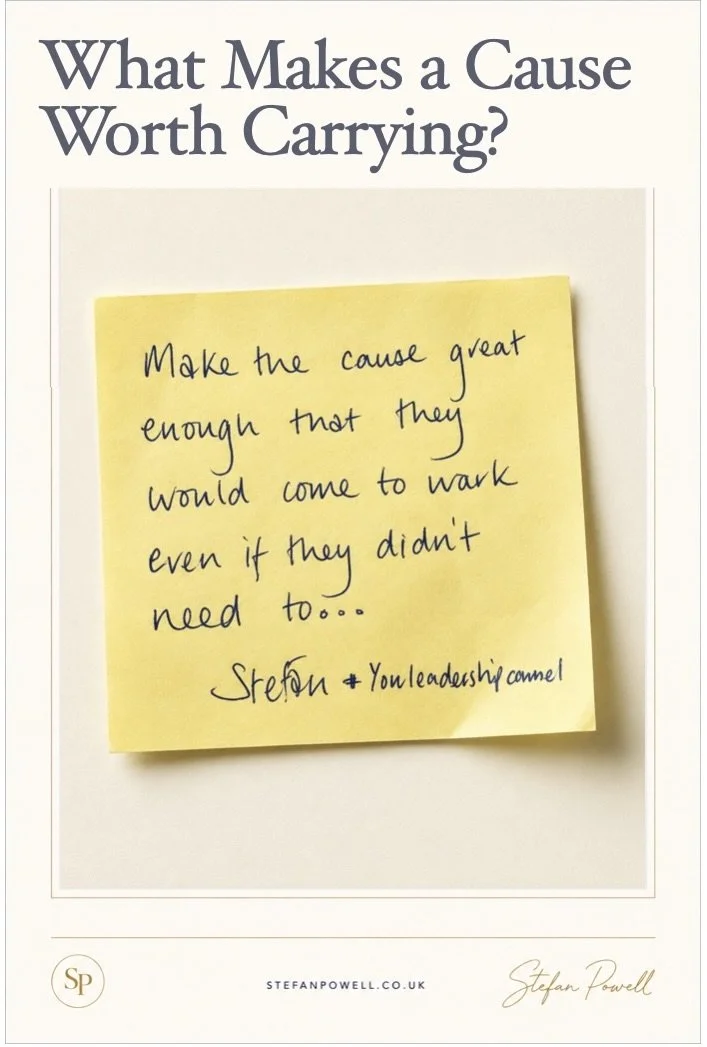
Recently, I found a note I’d written years ago.
A yellow Post-it. Scribbled quickly. Long forgotten.
It read:
“Make the cause great enough that they would come to work even if they didn’t need to.”
At first, I smiled.
Then I sat with it for a while.
At this time, leading change and transformation at work was - ‘my all’, and ‘my everything’.
Why? Because seeking the approval of those who’d asked me to deliver transformation whilst serving the people within it and the wider organisation - drove me to do what one project managers recorded as the “…work of 3.5 people’ in the RACI.
I think I’ve always worked with, and towards, something much deeper though.
What makes people care enough to contribute?
What makes somebody keep going when things get difficult?
What makes a founder push through uncertainty?
What makes a leader challenge a system that isn’t working?
What makes someone give their evenings, weekends, energy, reputation, and sometimes even their health to something they believe in?
Because when I look back across my own life, the things that mattered most were never driven by motivation alone.
They were driven by conviction.
And conviction rarely appears from nowhere.
It is usually born from experience.
And I think it’s that understanding and compassion of this inner turmoil, which enabled me to get large swathes of people, over the years, to ‘follow me’ or more importantly - ‘the cause’.
But how does that happen?
I think it comes from recognising the above, learning to hold ‘it’, and then showing compassion through action and stewardship for the journey we’ve all faced into. Where does it start?
Well…
First, We Get Burned
Most of us carry stories.
Experiences that shaped us.
Moments where something wasn’t right.
A poor leader.
A toxic culture.
A broken system.
A missed opportunity.
A decision that harmed people.
A moment when we realised things could, and should, be better.
The experience leaves a mark.
Not because we enjoy remembering it.
Because we don’t.
But some experiences stay with us.
Sometimes for years.
Sometimes for decades.
And sometimes they become the reason we decide to build something better.
Many leaders begin here.
Not with a vision.
With a frustration.
Not with a dream. But, with a determination that there must be a better way.
Then…
Then, We Stop Thinking Only About Ourselves
Something interesting happens as we mature - regardless of age.
At first, we want to avoid our own pain.
Later, we want to prevent it for others.
The leader who was never listened to creates space for others to speak.
The founder who struggled to find support helps others navigate the same challenges.
The coach who doubted their agency; but helps find it for others.
The parent who lacked stewardship but is determined to build it for their children.
At some point the story stops being about us and that’s when things get interesting.
The cause becomes bigger than us.
We stop asking:
“How do I avoid this?”
And start asking:
“How do I help others avoid it too?”
Possibility Comes Next
At some point, a different future becomes visible.
Not guaranteed. Not easy. Just possible.
We begin to see what could be.
A healthier organisation.
A stronger community.
A more effective team.
A better service.
A more just society.
A thriving planet.
Once you can see a different future, it’s surprisingly hard to unsee it.
As Viktor Frankl observed:
“Those who have a ‘why’ to live can bear almost any ‘how’.”
Perhaps that’s because purpose changes our relationship with difficulty.
The challenge remains.
But so does the reason for facing it.
And face into it, we must, if we are to truly live with purpose.
Then Responsibility Arrives
For me, this is where leadership begins to evolve into stewardship.
Leadership often asks:
“What can I achieve?”
Stewardship asks:
“What are we responsible for?”
Not because we have all the answers. Not because we hold all the authority.
But because we can see something that matters.
We choose not to walk past it.
We recognise that our actions affect others.
That our decisions ripple beyond ourselves.
That future generations will inherit the consequences of what we build, protect, neglect, or destroy.
This is the point where caring becomes responsibility.
Many of my clients ask - how do you have so much patience and how do manage to challenge me with such care? In my words - it’s because I know what it is to live in the absence of it.
And i’ve spent a lot of time shaping the ‘fire I have inside’, and learning to re-direct it, towards helping people find their way forward - and that’s become my cause.
Next we must ask ourselves…
What Is Worth Carrying?
I’ve spent much of my career helping leaders navigate complexity.
Leading transformation.
Supporting change.
Building businesses.
Coaching.
Facilitating.
And a couple of years ago, I spent a year training for a 1,000-kilometre bike race.
Why? Not because anybody asked me to.
Not because it made sense.
Because something inside me wanted to know whether I could and underaneath it all, I knoew it would make me better at helping others ‘work through pain’ and to return to coaching and transformation, with even greater levels of insight and compassion.
Looking back, the question of what makes a cause worth carrying, sits surprisingly close to many of the others.
What is worth the effort?
What is worth the sacrifice?
What is worth continuing when things become difficult?
The reality is, that it’s always calling you - from early in your life - you just have to listen to it.
More recently, I’ve found myself increasingly interested in stewardship.
Not because it’s at the opposite end of the spectrum to leadership.
No, but because it feels like a natural extension of it.
A leader asks:
“What can we accomplish?”
A steward asks:
“What is worth carrying?”
What deserves our effort?
What deserves our courage?
What deserves our time?
What deserves our contribution?
Those questions matter because every one of us is carrying something.
A family.
A team.
A business.
A community.
A responsibility.
A dream.
A cause.
The challenge isn’t whether we are carrying something.
The challenge is whether what we are carrying is worthy of us. And if it’s not, finding something that is.
The Causes Worth Carrying
Looking back at that old Post-it note, I think I’d write it differently today.
Not: “Make the cause great enough that they would come to work even if they didn’t need to.”
But: “Make the cause meaningful enough that people choose to contribute.”
Because contribution is voluntary.
You cannot mandate it. You cannot force it. You cannot demand it.
You can only create the conditions where people decide:
“This matters enough for me to give something of myself.”
And when that happens, extraordinary things become possible.
People become:
Clearer.
Calmer.
Braver.
More capable.
Less alone.
They stop asking:
“Can this be done?” And start asking: “How do we make it so?”
In my mind, that’s what the responsibility or rather act of leadership is really for.
Not status.
Not power.
Not recognition.
But Contribution.
And when we contribute and we ask others to do so too, for people, place and planet - that leadership becomes stewardship.
My question to you is: What cause is worth carrying, for you?
And:
What would help you carry it?
If something in this resonates - or you’re trying to think something through, or want to carry responsibility better - just reply.
stefan@stefanpowell.co.uk